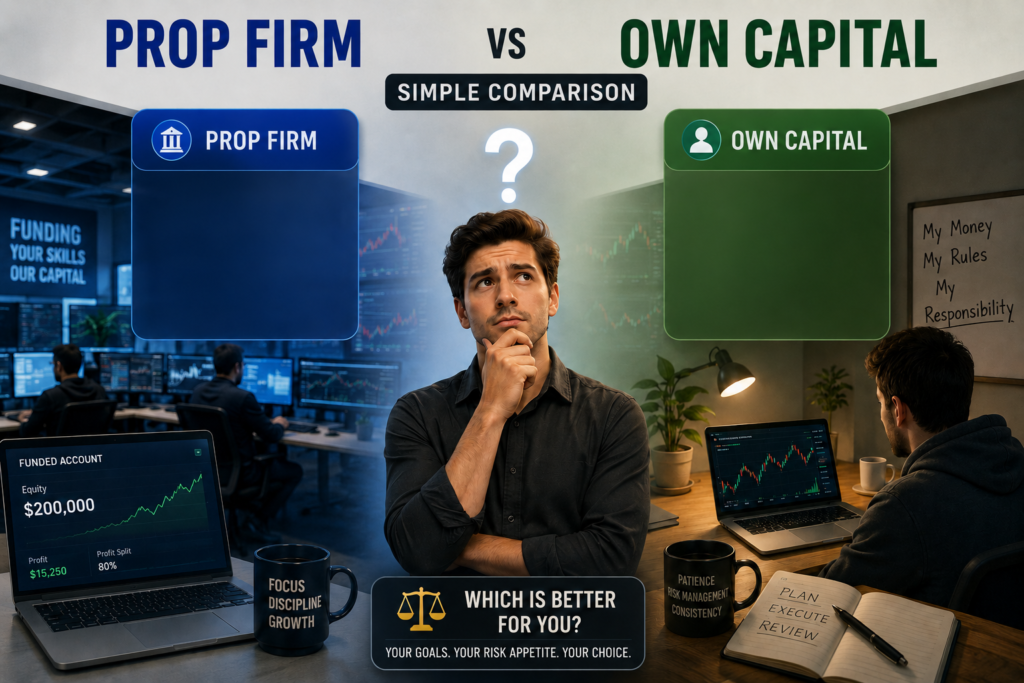
Is Prop Firm better than own capital? Yes, for many traders, a prop firm can be more beneficial than trading with their own capital. However, the answer is not the same for everyone.
It depends on your trading skills, experience, risk management, and how much capital you already have available. In simple terms, a prop firm gives you trading capital that you do not own. You trade with that capital under rules and share the profit.
On the other hand, own capital trading means you use your personal money and take full responsibility for profit and loss. Now let’s understand both sides in detail so you can decide clearly.
What Is a Prop Firm?
A prop firm is a company that funds traders with its own capital. You don’t need a big personal account to start trading. Most traders like prop firms because they give access to large capital. But you must prove your skill first before getting funded. A prop firm gives you money to trade and takes a share of your profit.
How it works:
- You join an evaluation or challenge
- You follow strict trading rules
- You show consistent profit and risk control
- If you pass, you get a funded account
Example: If you trade a $50,000 funded account and make $2,000 profit, you may keep 70%–90% depending on the firm.
What Is Trading with Own Capital?
Trading with your own capital means you use your personal money to trade in the market. No firm gives you funding or rules. This method gives full freedom, but it also puts all risk on you. You trade your own money and keep full control over everything.
Key points:
- You open your own trading account
- You deposit your own money
- You make all trading decisions
- You take full profit and full loss
Example: If you invest $1,000 and make $200 profit, the full $200 is yours. But if you lose $200, it is also your loss.
Prop Firm vs Own Capital- Simple Comparison
When traders search for “Is Prop Firm Better Than Own Capital ?”, they usually want a clear comparison. The answer depends on skill, experience, risk control, and available capital. Let’s understand both options side by side:
| Feature | Prop Firm | Own Capital |
| Money source | Firm funds | Your money |
| Risk level | Low personal risk | High personal risk |
| Profit share | Shared | 100% yours |
| Rules | Strict rules | No rules |
| Growth speed | Fast with skill | Depends on capital |
| Pressure | Evaluation pressure | Financial pressure |
| Promo Code | On Challenge fees | On Deposit |
How Prop Firm Trading Works
Prop trading is not random trading. It follows a system. The firm checks your discipline and risk management before giving you real capital. This system is made to protect the firm’s money and test your trading behavior.
Basic steps:
- You buy a challenge account
- You trade under fixed rules
- You must hit profit target
- You must stay inside loss limits
- If successful, you get funded capital
Common rules:
- Daily loss limit (you cannot lose more than a fixed % in a day)
- Max drawdown limit (overall account protection limit)
- No over-risking trades
- Consistency requirement
If you break rules, your account gets closed even if you are profitable.

Pros of Trading with a Prop Firm
Prop firms are very popular because they reduce personal financial pressure.
Benefits:
- You don’t risk your own large capital
- You get access to big trading accounts
- Good option for low-capital traders
- Helps improve discipline
- Fast scaling opportunities if you perform well
Best for:
- New traders
- Small capital traders
- Traders who follow rules strictly
Cons of Trading with a Prop Firm
Prop firms also come with strict conditions. Many traders fail because of rules, not trading skill.
Drawbacks:
- Strict rules and limits
- Challenge fee required
- You can lose account even after profit
- Profit is shared, not 100% yours
- Emotional pressure during evaluation
Pros of Trading with Own Capital
Own capital trading gives full independence. You control everything without external rules.
Benefits:
- Full control over trading decisions
- 100% profit stays with you
- No evaluation or restrictions
- You can trade your own style freely
- Long-term wealth building potential
Best for:
- Experienced traders
- Traders with enough capital
- Independent decision makers
Cons of Trading with Own Capital
This method gives freedom, but also increases personal risk.
Drawbacks:
- You risk your own money
- Small capital limits growth
- Emotional stress during losses
- Slower progress for beginners
- Hard to scale without big capital
Which Is More Beneficial in Prop Firm Vs Own Capital?
Is Prop Firm Better Than Own Capital? There is no single answer for everyone. Both options can be profitable if used correctly.
Prop firm is better if:
- You don’t have enough trading capital
- You want lower financial risk
- You can follow strict rules and discipline
- You want faster access to big capital
Own capital is better if:
- You already have strong capital
- You want full freedom in trading
- You are emotionally strong in losses
- You prefer long-term independent growth
Simple conclusion:
- Prop firms reduce risk but add rules
- Own capital gives freedom but increases risk
FAQs
1. Is Prop Firm Better Than Own Capital?
A prop firm can be better if you want big trading capital without using your own money. But it depends on your skill and discipline.
2. Do prop firms give real money?
Yes, funded accounts use real capital provided by the firm.
3. What is the biggest risk in prop firms?
Breaking rules and losing your funded account, even if you are profitable.
4. Can beginners use prop firms?
Yes, beginners often start with prop firms due to low capital needs.
5. Which is easier: prop firm or own capital?
Prop firms are easier to start, but harder due to strict rules.